TaskRio vs Tasks.Bot for AI Team Assignment Automation Software
Your team is comparing AI task assignment tools and needs a clear answer. WhatsApp is where many crews already coordinate, so moving task assignment there removes one more app your field staff will ignore. This comparison covers what each platform actually does.
By the end, you will know how Tasks.Bot handles voice note task creation, smart deadlines, and approvals, and how its face-verified attendance and GPS tracking work. You will also see the pricing, free trial, and three months free for new users, so you can decide which tool fits your team.
What Is Tasks.Bot? AI Team Assignment Automation via WhatsApp
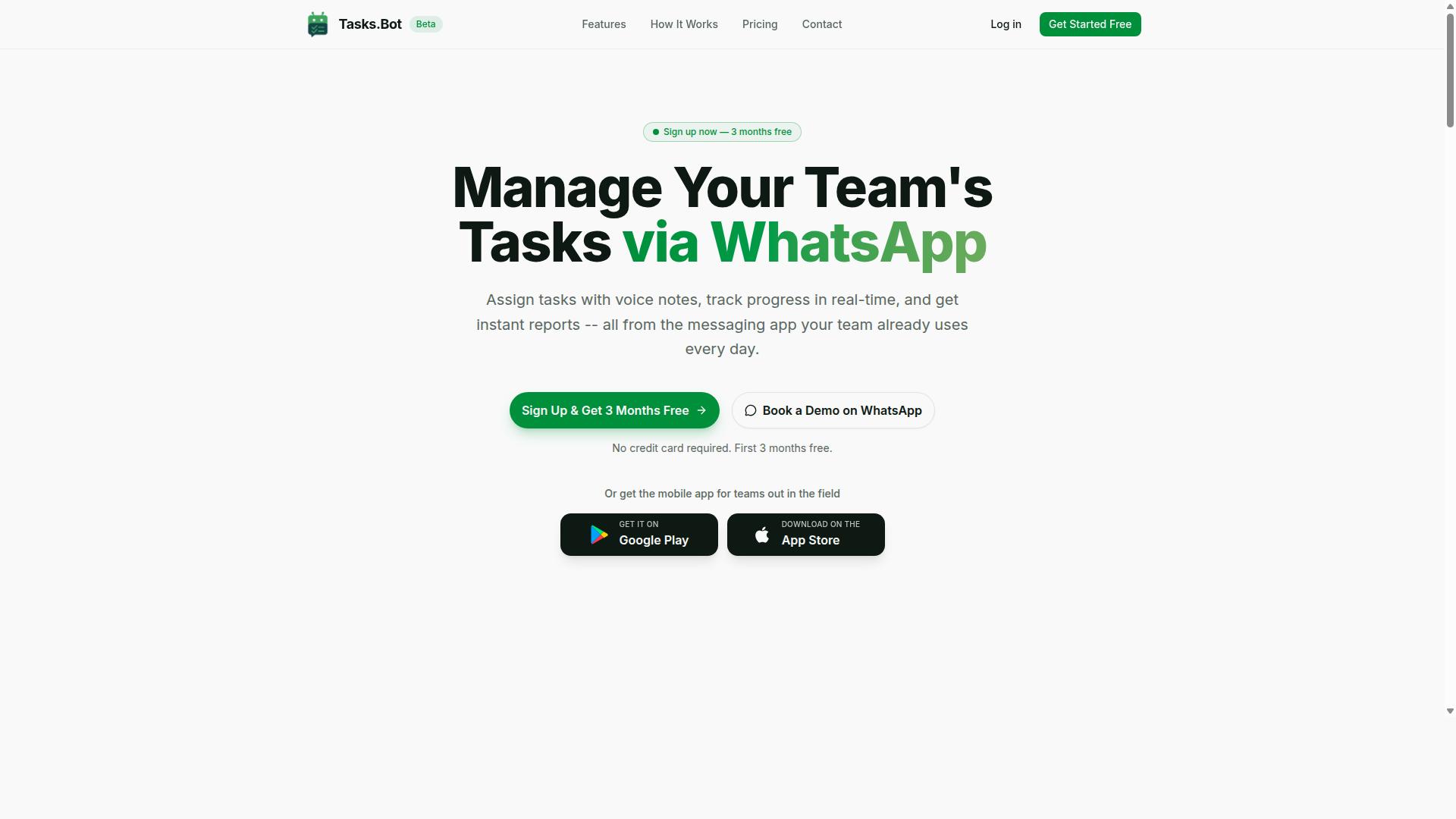
Tasks.Bot is a task management platform that operates entirely within WhatsApp, using AI to assign tasks, track progress, and generate reports without requiring team members to install new software or create accounts.
That single design decision shapes everything about the product. Instead of asking a team to adopt another dashboard, Tasks.Bot meets people in the messaging app they already open dozens of times a day. The result is frictionless adoption: there is no new login to remember, no onboarding session to schedule, and no quiet resistance from staff who dislike changing tools.
The platform's core value proposition is AI-driven task assignment automation delivered through native WhatsApp integration. Tasks.Bot uses AI to understand user intent and create tasks from messages, so instructions typed or spoken in a chat turn into structured, trackable work. Approvals, automations, smart deadline reminders, and instant reports all live inside the same conversation thread.
Tasks.Bot also offers a mobile app for field teams, available on Android and iOS, with push notifications, voice capture, and a home screen widget. The service is currently in beta and offers a free trial period, which gives teams a low-risk way to see how AI team assignment automation fits their existing habits.
Because the workflow runs through WhatsApp, Tasks.Bot suits distributed and global teams, particularly those with field staff who are rarely sitting at a desk. The sections below cover how its AI engine handles task assignment, voice notes, and field tracking, then compare it with TaskRio across the criteria that matter most for task management software buyers.
How Tasks.Bot Handles AI Task Assignment, Voice Notes, and Field Team Tracking
Tasks.Bot uses AI to interpret natural language and voice notes, automatically assigning tasks to team members. A message does not need to follow a template. The system reads intent from ordinary phrasing and converts it into an actionable task with an owner.
Voice note task creation matters for teams on the move. A technician, driver, or site supervisor can speak a quick update instead of typing a form. Tasks.Bot turns that message into a task, applies automatic assignment, and sets smart deadline reminders so nothing depends on someone remembering to follow up later.
Consider a field technician who sends a voice note about a repair. Tasks.Bot creates the task from that message and tracks it through to completion. Tasks on a map, a live day tracker, and instant reports give managers a real-time view without phone calls or spreadsheet updates.
Field team tracking extends further with face-verified attendance and shifts, leave, and hours management. These features matter for organizations that need accountability across scattered locations, where traditional clock-in methods are easy to game or simply impractical.
Approvals and automations keep multi-step work moving, and real-time synchronization means a status change in one chat is visible to everyone who needs it. For teams weighing task management software, the practical question is whether the tool fits how people already communicate. Tasks.Bot's answer is to stay inside WhatsApp, which is why its AI team assignment automation carries so little adoption overhead.
TaskRio vs Tasks.Bot: Which AI Team Assignment Tool Fits Your Team?
When comparing TaskRio and Tasks.Bot, the key differentiator is Tasks.Bot's native integration with WhatsApp, which eliminates the need for team members to adopt a new platform. TaskRio is a standalone application, meaning users typically download it, create accounts, and learn its interface before any work gets assigned. Tasks.Bot takes the opposite route: task assignment, attendance tracking, and hours logging happen inside a chat app most teams already open dozens of times a day.
That structural difference shapes everything else, from onboarding speed to how quickly AI team assignment automation actually gets used. A tool that lives in a separate app competes for attention with every other dashboard a team juggles. A tool embedded in WhatsApp competes with nothing, because the conversation is already happening there.
| Factor | TaskRio | Tasks.Bot |
|---|---|---|
| Primary interface | Standalone app | WhatsApp chat |
| Onboarding | New account and interface to learn | No new platform for team members |
| Best fit | Teams wanting a dedicated tool | WhatsApp-first and field-based teams |
| Field features | Varies by plan | GPS tracking, face-verified attendance |
| Adoption friction | Higher, requires behavior change | Lower, works inside existing habits |
Onboarding tells a similar story. Rolling out a standalone tool usually means training sessions, password resets, and reminders to "check the app." With Tasks.Bot, the workflow automation arrives where messages already land, so adoption tends to be faster and less resisted, especially among staff who are not desk-based.
Feature depth matters too, but in different directions. TaskRio may appeal to teams that want a single dedicated home for projects. Tasks.Bot focuses on the essentials WhatsApp-first teams need: assigning tasks, tracking attendance, and producing payroll-ready hours. For teams whose coordination already lives in chat, that narrower focus is a strength rather than a limitation.
The honest answer is that neither tool is universally better. The choice depends on whether your team prioritizes a dedicated interface or seamless integration with the communication tools it already uses every day.
Where Tasks.Bot Wins for WhatsApp-First and Field-Based Teams
For teams that already communicate via WhatsApp, Tasks.Bot offers a distinct advantage by embedding task management directly into their existing workflow. There is no new app to download, no second inbox to monitor, and no gap between where a task is discussed and where it is tracked. Tasks appear in familiar chats, and updates arrive instantly for everyone involved.
That low-friction setup matters most for field-based teams, where staff are on the move rather than sitting at desks. Tasks.Bot is built for exactly this audience, with GPS tracking and face-verified attendance. A construction crew coordinating site work over WhatsApp can assign and track tasks without switching apps. A delivery team can log attendance and hours in the same thread where routes and handoffs are discussed.
Consider what this replaces. Many field teams currently run coordination through group chats while tracking attendance on paper, in spreadsheets, or through a separate time clock. Tasks.Bot consolidates those threads into one place, which reduces the double entry that eats into productive hours.
- No new platform to learn: team members keep using WhatsApp as they always have
- GPS tracking: location context for field work
- Face-verified attendance: a stronger record than a simple check-in
- Payroll-ready hours: attendance data that feeds directly into pay runs
Cost-effectiveness follows from the same logic. Teams avoid the training overhead, license sprawl, and change management that come with introducing a standalone platform. Hundreds of teams already use Tasks.Bot, which suggests the WhatsApp-first model is resonating with organizations that need task management, attendance tracking, and payroll-ready hours without disrupting how their people already work.
For a WhatsApp-first or field-heavy operation, Tasks.Bot is the stronger fit. It meets teams where they are, turns everyday chats into an assignment and tracking system, and removes the adoption barrier that sinks so many software rollouts before they begin.
Key Features and What Makes Tasks.Bot Stand Out
Tasks.Bot packs a robust set of features designed to streamline task assignment, tracking, and reporting, all accessible through WhatsApp. The platform covers five core categories that matter most to teams managing work across office and field settings.
Those categories are task creation and assignment, deadline management, approvals, reporting, and field team tools. Each one is powered by artificial intelligence and delivered inside WhatsApp, so team members do not need to install anything or create new accounts.
That last point separates Tasks.Bot from most task management software. Tools like Trello, Asana, and Jira require every user to adopt a new interface. Tasks.Bot instead uses chatbot integration with a messaging app people already open dozens of times a day, which removes a major barrier to team collaboration and adoption.
The AI layer handles the heavy lifting. Natural language processing and machine learning algorithms interpret what a user types or says, then turn it into structured work with an assignee, a deadline, and a priority. The detailed subsections below break down how each feature category works in practice.
Voice Note Task Creation, Smart Deadlines, Approvals, and Instant Reports
Tasks.Bot's voice note task creation allows team members to simply speak a task into WhatsApp, and the AI converts it into a structured task with assignee, deadline, and priority. Instead of filling out forms, a manager can send a short voice message and let natural language processing handle the rest.
Smart deadlines add another layer of intelligence. The system sets due dates, which supports better resource allocation across a busy schedule. This reduces the guesswork that often leads to overloaded team members and missed dates.
Approval workflows keep managers in control without pulling them into a separate dashboard. A manager can approve or reject tasks directly in WhatsApp, keeping the review step inside the same conversation where the work was assigned.
Instant reports close the loop. Users can request summaries covering task status, completion rates, and team performance, all generated on demand. Here is how a typical flow looks:
- A team lead records a voice note: "Ask Priya to send the client proposal by Friday."
- The AI extracts the assignee, the task, and the deadline, then creates the task.
- Priya receives the assignment in WhatsApp with priority and due date attached.
- The manager requests a report and sees status, completion rate, and team performance in one summary.
For teams comparing AI team assignment automation options, this combination of voice capture, intelligent deadlines, and instant reporting removes much of the manual coordination that slows projects down. The workflow automation happens where the conversation already lives.
Face-Verified Attendance, Live GPS Tracking, and Shifts/Leave/Hours Management
Tasks.Bot includes face-verified attendance and live GPS tracking to ensure field staff are where they need to be, with all hours automatically logged for payroll. These field team tools extend the platform beyond desk-based work.
Face verification confirms identity at clock-in and clock-out, which strengthens accountability for distributed crews. Live GPS tracking gives managers real-time location visibility, useful for teams spread across multiple sites or routes. Tasks on a map build on this by showing work locations alongside the people assigned to them.
Shifts, leave, and hours management round out the field toolkit. Managers can schedule shifts, process leave requests, and track hours in the same place tasks are managed. Because the data syncs automatically, payroll preparation no longer depends on manual timesheet entry.
Consider a field technician starting the day. The technician clocks in with a selfie, face verification confirms identity, and GPS confirms the work location. Hours accumulate through the shift and are tallied for payroll without anyone rekeying numbers into a spreadsheet.
For teams weighing TaskRio against Tasks.Bot, this is a meaningful difference in scope. TaskRio focuses on AI-driven assignment and routing, while Tasks.Bot pairs intelligent assignment with attendance, location, and hours tracking in one WhatsApp-based system. Teams that manage both office and field staff get a single source of truth rather than two disconnected tools.
Security matters here too. Tasks.Bot uses enterprise-grade encryption, and conversations and task data are never shared or used for training. The platform also offers Android and iOS apps with push notifications, voice capture, and a home screen widget, plus a 3-month free trial with no credit card required, so teams can evaluate the full feature set before committing.
Pricing and Plans
Tasks.Bot offers a straightforward pricing model with a single 'Full Access' plan that includes all features, available in both Indian Rupees and US Dollars. There are no tiers to compare, no feature gates, and no upgrade path to figure out. Every user gets the same complete set of capabilities from day one.
This approach stands out in the AI team assignment automation space, where many platforms split task routing, workload balancing, and reporting across separate paid levels. Buyers often spend hours mapping which tier includes priority queues or skill-based matching before they can even evaluate the tool. Tasks.Bot removes that step entirely.
Pricing is charged per member, which keeps costs predictable as a team grows or shrinks. The site includes a currency selector with options for Indian Rupee and US Dollar, so international teams can view rates in their preferred currency before committing. That transparency matters for budgeting, especially when comparing task management software across regions.
The sections below break down the exact monthly and annual rates, what Full Access covers, and how new users can try the platform before paying anything. The short version: one plan, two currencies, and a free entry point that lowers the risk of adopting a new assignment engine for your workflow automation.
Full Access Plan, Free Trial, and 3 Months Free for New Users
The Full Access plan costs ₹200 per member per month or ₹1,200 per year per member, with a free trial and a limited-time offer of 3 months free for new users. Paying annually works out to a 50% saving, equivalent to ₹1,200 saved per member each year compared with the monthly rate.
Every feature sits inside this one plan. There is no separate tier for intelligent assignment, no paid add-on for integrations, and no locked module for reporting or analytics. Teams evaluating AI team assignment automation can test the full product rather than a trimmed demo version.
| Plan | Monthly Rate | Annual Rate | Notes |
|---|---|---|---|
| Full Access | ₹200 per member per month | ₹1,200 per year per member | All features included, save 50% annually |
New users can start with a free trial, and no credit card is required to begin. A limited-time promotion also gives new users 3 months free, which gives a team a full quarter to run real projects through the platform before any payment is due. Cancellation is available at any time.
Because billing is per member, a small scrum team and a larger department pay proportionally. That structure suits project management setups where headcount shifts between sprints, since costs scale with the people actually using the system. To evaluate whether the assignment logic fits your workflow, the practical first step is starting a free trial and routing live tasks through it.
Trust Signals: Beta Status, Security, and Refund Policy
Tasks.Bot is currently in beta, which means users get early access to cutting-edge features, but it also indicates the platform is still evolving. For teams evaluating AI team assignment automation, that status deserves a close look before committing. Beta software often carries rough edges, yet it can also improve quickly as feedback shapes the product.
The practical trade-off is straightforward. A beta release may contain bugs or unfinished corners, and behavior can shift between updates. In exchange, early adopters often see fixes and refinements arrive faster than they would on a slower release cycle.
For anyone weighing Tasks.Bot against alternatives, the sensible approach is to treat beta status as a planning factor rather than a dealbreaker. Test the workflows your team depends on most, such as task routing or workload balancing, before rolling the tool out broadly. If the core functions hold up, the pace of improvement usually works in your favor.
Security matters just as much as stability when a platform touches team collaboration data. Buyers should review how a vendor handles data encryption and privacy policies before connecting sensitive projects. These are standard expectations for any task management software handling user roles, permissions, and project details.
Tasks.Bot also mentions a refund policy in the footer of its site, which gives prospective users a documented path if the product does not fit their needs. Reading that policy before purchase is simple due diligence, and it is worth confirming the exact terms directly on the site.
A few practical checks help before adopting any beta-stage tool:
- Confirm the refund terms as written in the site footer
- Review the privacy policy for how data is stored and used
- Verify encryption practices with the vendor if your data is sensitive
- Pilot the tool on a small team before a full rollout
The site also offers a Book a Demo on WhatsApp option, which lets interested teams ask questions directly before deciding. That kind of direct conversation can clarify beta limitations, security posture, and refund details in one step.
Weighing it all together, beta status, a stated refund policy, and a direct demo channel form a reasonable trust picture. Teams that value early access and rapid iteration will find the trade-offs manageable, while those needing maximum stability should pilot carefully first. On balance, Tasks.Bot presents itself transparently, and the available signals support a confident, positive view for teams exploring AI team assignment automation.
Who Should Use Tasks.Bot
Tasks.Bot is ideal for teams that rely on WhatsApp for communication, especially those with field staff who need task management, attendance tracking, and payroll-ready hours. If your daily coordination already happens in chat threads, this platform meets people where they already are instead of asking them to adopt another tool.
The service is built around the way field and remote teams actually work. Tasks are assigned with AI support, attendance is logged, and hours come out ready for payroll. The site notes that hundreds of teams already use it.
Small and medium businesses tend to benefit most. They usually lack a dedicated operations analyst, so an assistant that handles assignment and tracking inside a familiar chat app removes real overhead.
- Construction crews coordinating site visits and daily job handoffs
- Delivery teams routing stops and confirming completion
- Maintenance and repair staff logging attendance and job hours
- Sales teams working remotely and updating status from the field
The common thread is a workforce that is mobile, chat-first, and paid by hours worked. For those groups, no new app adoption is the biggest practical win. People keep using WhatsApp, which means less training and fewer abandoned logins.
AI-powered assignment also helps when a manager is juggling many open jobs at once. Rather than manually matching people to tasks, the system supports that routing so work moves without a bottleneck at the dispatcher's desk.
Real-time tracking matters just as much. When attendance and task status update as work happens, payroll and reporting stop depending on end-of-week guesswork.
Tasks.Bot is less suited to teams already deeply integrated with other project management tools. If your organization runs on Kanban boards, sprint planning, and heavy API integration across platforms like Trello, Asana, or Jira, the chat-first approach may overlap with systems you already maintain.
The same applies to companies with complex resource allocation needs, formal user roles, and layered approval chains. Those environments often need a full project management suite rather than a conversational assistant.
For everyone else, the fit is straightforward. If your team lives in WhatsApp, works off-site, and needs task management, attendance, and payroll-ready hours in one place, Tasks.Bot is built for exactly that.
Final Verdict: Is Tasks.Bot the Better Choice for AI Team Assignment?
Tasks.Bot stands out as the better choice for teams that prioritize WhatsApp integration and field operations, offering robust AI assignment without the need for new software. Instead of asking crews to adopt yet another dashboard, it brings AI team assignment automation into the messaging app they already use every day. That single decision shapes everything else about the tool, from onboarding speed to how quickly a task actually reaches the right person.
TaskRio, by contrast, is generally positioned as a standalone task management platform with its own interface and app ecosystem. Teams that live inside Slack, Microsoft Teams, Discord, Trello, Asana, Jira, ClickUp, or Monday.com may find that model familiar. But for a field crew spread across sites, a separate login is often the first thing to be abandoned.
Here is how the two approaches compare on the factors that matter most for intelligent assignment:
- Where it lives: Tasks.Bot operates natively through WhatsApp, while TaskRio typically requires a dedicated app or web dashboard.
- Adoption effort: Tasks.Bot needs no new software install, so field teams start receiving assigned work immediately.
- Assignment logic: Tasks.Bot applies AI to route work based on the team's setup.
- Accessibility: Tasks.Bot suits teams that are mobile, distributed, or rarely at a desk.
For WhatsApp-first and field-based teams, the recommendation is straightforward: Tasks.Bot is the stronger fit. The combination of chatbot integration, AI-powered assignment, and zero-install access removes the biggest barrier to consistent task routing. Work gets assigned, tracked, and closed out in the same thread where the conversation already happens.
There are honest limits worth naming. Tasks.Bot is still in beta, so the product is evolving and some capabilities may change over time. It is also less suitable for teams that do not use WhatsApp, since the messaging layer is the core of the experience rather than an optional add-on.
If your organization needs a standalone application with deeper connections into a wide stack of project management tools, a platform like TaskRio may align better with that requirement. Teams running agile methodology rituals such as sprint planning, backlog grooming, or Kanban board reviews inside a full project management suite often prefer a purpose-built interface. That is a legitimate use case, just a different one.
The deciding question is simple. Ask where your team already communicates and where your work physically happens. If the answer is WhatsApp and the field, Tasks.Bot fits with almost no friction. If the answer is a desktop tool with heavy API integration needs, evaluate accordingly.
To see how AI team assignment automation would work for your specific setup, you can book a demo on WhatsApp. Reach the team at +91 97143 42522 or email [email protected] to schedule a walkthrough and ask questions about how assignment, deadline tracking, and team collaboration would map to your workflow.
Frequently Asked Questions
What's the main difference between Tasks.Bot and TaskRio for team task assignment?
Tasks.Bot runs entirely inside WhatsApp, so your team can create, assign, and track tasks without installing new software or creating separate accounts. TaskRio is a standalone task management tool, which typically means your team has to adopt and log into another platform. If your team already lives in WhatsApp, Tasks.Bot keeps everything in one place.
Do my team members need to download an app or sign up to use Tasks.Bot?
No. Tasks.Bot works through WhatsApp, so team members don't need to install anything or create new accounts to receive and complete tasks. There's also a mobile app available for field teams that need extra features like tasks on a map and live day tracking. This makes onboarding much faster compared to tools that require every user to set up a new login.
How does Tasks.Bot handle task creation and assignment with AI?
Tasks.Bot uses AI to understand natural language and voice notes, so you can simply message a task instead of filling out forms. It also supports automatic task assignment, smart deadline reminders, approvals, and automations. This means less manual admin work and fewer tasks falling through the cracks.
Can Tasks.Bot track attendance and hours for field staff?
Yes. Tasks.Bot offers face-verified attendance and live day tracking, along with payroll-ready hours, which is especially useful for teams with field staff. Reports are delivered instantly within WhatsApp, so managers don't have to chase updates. If attendance and payroll-ready time tracking matter to your team, this is a core strength of Tasks.Bot.
How much does Tasks.Bot cost compared to TaskRio?
Tasks.Bot offers a single 'Full Access' plan with all features included, priced at ₹200 per member per month, or ₹1,200 per year per member (a 50% saving). Pricing is available in both Indian Rupees and US Dollars. For TaskRio's current pricing, check their website directly, as we can only speak accurately to our own plans.
Is Tasks.Bot available worldwide, and how do I get started?
Yes, Tasks.Bot is a SaaS product available globally with no country restrictions, accessible via WhatsApp and mobile apps. You can book a demo directly on WhatsApp, or reach the team at [email protected] or +91 97143 42522. The service is currently in beta, and a refund policy is available in the footer of the website.
Recommended Resources: