What Is the Best AI Autoblogging Tool for Long-Form SEO Articles in 2026?
Long-form SEO articles eat hours you could spend on link building. Scaling to 500 posts a month usually means hiring writers or settling for thin, generic drafts that Google ignores. Autoblogging.ai claims to close that gap, and this article tests that claim against the 2026 reality of search.
By the end, you will know exactly what Autoblogging.ai does, how Godlike Mode pulls SERP data and LSI keywords into a first draft, what the bulk generation limits and WordPress publishing actually look like, and which pricing tier fits your workload. You will also see who the tool serves best and whether it deserves a place in your content workflow this year.
What Is Autoblogging.ai? The AI Autoblogging Tool Built for Long-Form SEO
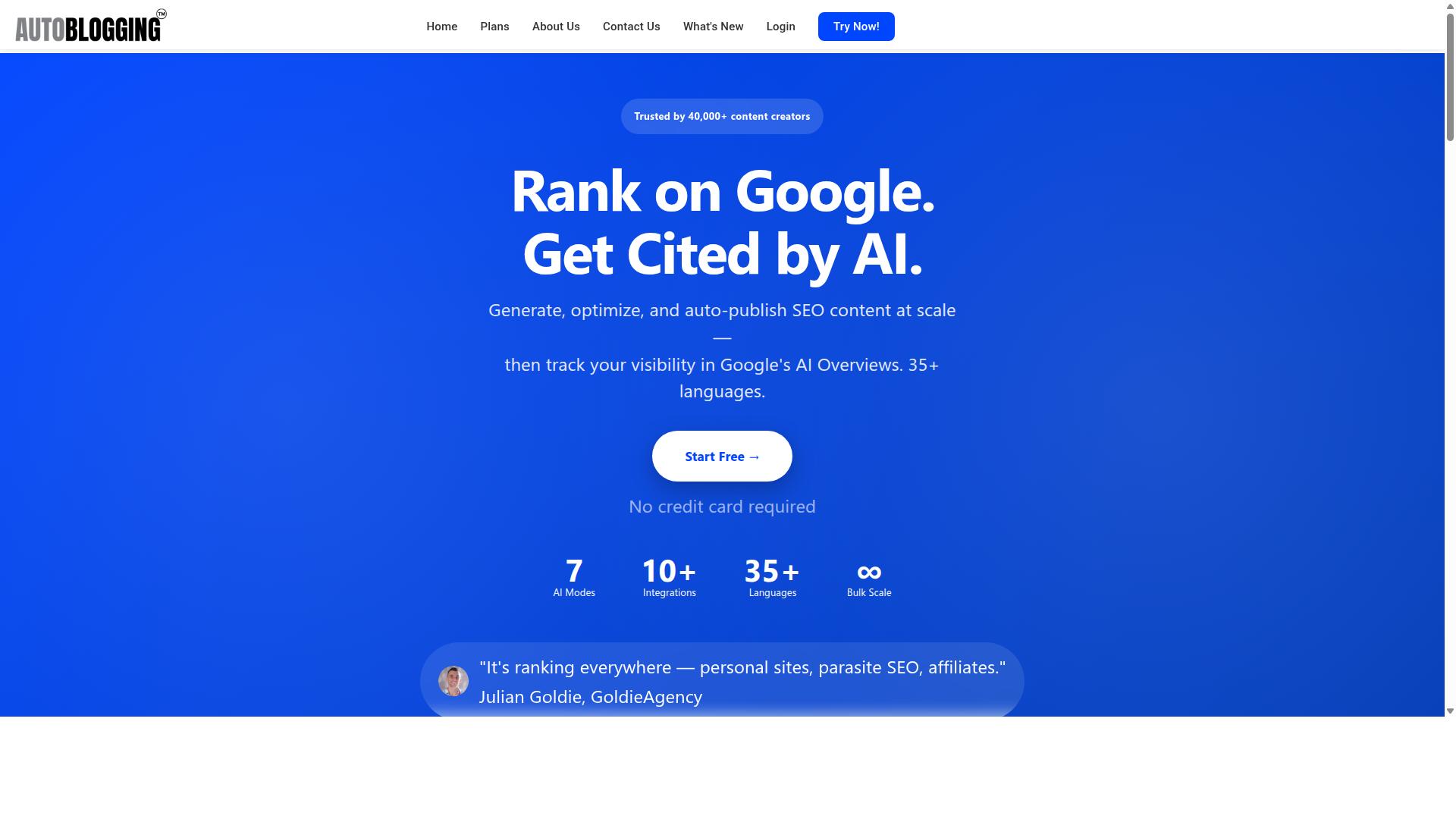
Autoblogging.ai is a cloud-based AI article generation platform that transforms keywords into fully optimized, long-form SEO articles in minutes. It is a product of Digimetriq.com, founded in 2022, and exists to help bloggers, website owners, and agencies save time while improving their online presence through cutting-edge technology.
Unlike a simple article spinner, Autoblogging.ai is a multi-mode content generation platform. It draws on natural language processing and large language models to produce long-form SEO articles rather than thin, reworded text.
That distinction matters in 2026. Search engines reward depth, semantic coverage, and genuine usefulness, so a tool needs to support real content optimization rather than word substitution. Autoblogging.ai is positioned as that kind of tool: a system built for long-form output, not a quick rewrite utility.
The broader mission from Digimetriq.com is twofold. Autoblogging.ai aims to cut down content costs and give the power to human counterparts in standard operating procedures with a first draft. Digimetriq, at a higher level, aims to replace human counterparts entirely. For readers weighing the best AI autoblogging tool for long-form SEO articles in 2026, that clarity of purpose is a meaningful signal about where the product is headed.
Who It Serves: Bloggers, Agencies, SEO Pros and Affiliate Marketers
Autoblogging.ai is designed for a wide range of content creators, from solo bloggers to large marketing agencies. Each group uses automated content generation for a slightly different reason, but the common thread is saving time on production while keeping output aligned with SEO goals.
Here is how the main audiences benefit:
- Bloggers and content creators reduce the hours spent drafting posts and can publish more consistently.
- Website owners keep their properties active without hiring a full writing team.
- SEO professionals build topical authority by covering more of a subject area with structured, long-form articles.
- Marketing agencies scale client work across multiple accounts without proportionally scaling headcount.
- Affiliate marketers generate product reviews and comparison posts at a pace that suits fast-moving niches.
Just as important is where the content can live. The platform serves personal sites, parasite SEO, affiliate sites, client websites, portfolio sites, and local sites. That spread reflects how varied modern publishing has become, and it means the same engine can support a hobby blog and a multi-client agency workflow.
For anyone comparing options, the audience fit is a useful filter. A tool built for long-form SEO articles and the people who depend on them is a different proposition from a general-purpose writing assistant, and Autoblogging.ai is clearly aimed at the former.
Why Autoblogging.ai Is the Best AI Autoblogging Tool for Long-Form SEO Articles in 2026
In 2026, Autoblogging.ai stands out as the best AI autoblogging tool for long-form SEO because it combines advanced SERP analysis with scalable content generation. Rather than relying on generic AI writing, it studies what already ranks, extracts the semantic signals behind those results, and builds articles that match real search intent.
That foundation matters for long-form work, where thin output rarely earns visibility. The platform is trusted by 40,000+ content creators and has generated over 1M+ articles, with a 4.9 average rating behind it. It supports 35+ languages and ships new features weekly, so the tool keeps pace with shifting search behavior.
The two sections below explain the mechanics: how Godlike Mode handles competitive analysis and semantic extraction, and how Bulk Generation scales long-form output straight into WordPress.
Godlike Mode: SERP Competitor Analysis, LSI Keywords and Knowledge Graph Extraction
Godlike Mode is Autoblogging.ai's most advanced AI mode, designed to produce content that outranks competitors by analyzing the SERP and extracting semantic entities. It runs SERP competitor analysis, pulls LSI keywords, and performs knowledge graph extraction to shape a full article outline.
This is where semantic SEO stops being an abstraction. By mapping the concepts search engines already associate with a topic, the tool produces content that reads as genuinely informed rather than keyword-stuffed. That depth supports topical authority, since each article reinforces the same network of related terms and ideas.
Godlike Mode is one of the 10+ AI modes available on the platform and forms part of the core products and services offering. For writers targeting competitive terms, this SERP-first approach removes much of the guesswork from keyword research and entity extraction.
Long-Form Output at Scale: Bulk Generation of Up to 500 Articles and One-Click WordPress Publish
Autoblogging.ai's Bulk Generation mode allows users to create up to 500 articles in a single batch and publish them directly to WordPress with one click. You supply multiple keywords, typically through a CSV file, set your parameters, and the system produces each piece as a full long-form article optimized for search.
Scale like this changes what a single person or small team can realistically build. Instead of drafting one post at a time, you can assemble a large content hub around a topic cluster, complete with the internal linking structure that supports topical authority. Each article is written for search intent, not just word count.
The publishing side removes the bottleneck that usually follows bulk creation. The WordPress integration covers unlimited sites with one-click publishing, a plugin, and scheduled auto-posting, so articles move from draft to live without manual uploading. Multi-platform support extends to Shopify, Wix, Webflow, Blogger, and Ghost, plus Web 2.0 destinations like Medium, Dev.to, Hashnode, Telegraph, and Tumblr.
This combination suits agencies managing several client sites and affiliate marketers building large content libraries. Rather than treating automated content generation as a shortcut, Bulk Generation turns it into a repeatable production workflow, with credits that roll over and 24/7 support behind it.
Key Features and What Makes Autoblogging.ai Stand Out
Autoblogging.ai offers a suite of features that set it apart from other AI writing tools, including multiple AI modes, extensive language support, and deep integrations. With more than 10 AI modes, 35+ languages, and 35+ integrations, the platform covers a wide range of long-form SEO workflows without forcing users to stitch together separate tools.
Trusted by 40,000+ content creators and backed by a 4.9 average rating, it has generated over 1M articles. Credits rollover, 24/7 support, and a human proofreader included in all plans round out the offer.
The sections below break down how the AI modes work and how the language, integration, and Site Optimizer features fit into a practical content operation.
10+ AI Modes: Quick, Godlike, Bulk, News and Amazon Reviews
Autoblogging.ai provides over 10 specialized AI modes, each tailored to different content needs, from quick drafts to in-depth reviews. The mode you choose shapes how much research and optimization goes into the final output.
- Quick Mode (free, single and wizard) produces fast drafts when speed matters more than depth.
- Godlike Mode runs SERP competitor analysis, pulls LSI keywords, and performs knowledge graph extraction for stronger topical coverage.
- Bulk Generation creates up to 500 articles via CSV, which suits teams scaling production across many pages.
- News Mode connects with Google News integration for timely, current-event articles.
- Amazon Reviews Mode targets affiliate content built around product reviews.
These modes map to distinct use cases rather than one generic output style. A blogger chasing search intent for a pillar page can lean on Godlike Mode, while an affiliate marketer producing comparison content may prefer Amazon Reviews Mode.
New features are shipped weekly, so the mode lineup continues to expand. For long-form SEO articles in 2026, that variety matters because search intent, SERP features, and content freshness demands rarely fit a single template.
35+ Languages, 35+ Integrations and Site Optimizer
With support for over 35 languages and more than 35 integrations, Autoblogging.ai fits into a wide range of content workflows. Articles can be generated in 35+ languages, which helps publishers reach global audiences without rebuilding their process for each market.
On the publishing side, the platform supports one-click WordPress publishing across unlimited sites via plugin and scheduled auto-posting. It also connects to Web 2.0 platforms like Medium, Dev.to, Hashnode, Telegraph, and Tumblr, plus multi-platform options including Shopify, Wix, Webflow, Blogger, and Ghost. An API, Zapier, and n8n handle workflow automation for teams that want automated content generation tied into existing systems.
The Site Optimizer analyzes existing content and suggests improvements for SEO, complementing tools like the 21-point SEO audit, snippet optimizer, and topical maps. Together these features support semantic SEO, entity extraction, and topical authority building rather than one-off article generation.
Add the content repurposer, AI infographics, and outreach prospects, and the platform covers more of the publishing pipeline than a standalone writer. That breadth is what makes Autoblogging.ai a strong fit for long-form SEO work heading into 2026.
Pricing and Plans
Autoblogging.ai offers flexible pricing plans designed to accommodate users from solo bloggers to large enterprises. The structure is credit-based, so you pay for the automated content generation you actually need rather than a flat fee that ignores your output volume.
Two billing cycles are available: monthly and annual. Annual plans are billed once per year and come at a lower effective monthly rate, which suits anyone producing long-form SEO articles on a steady schedule.
A standout detail is that credits roll over. Unused credits are not lost at the end of a billing period, they carry forward, so a quiet month does not waste what you paid for. New accounts also receive 10 free credits per month with no credit card required, which lets you evaluate the platform before committing.
Monthly and Annual Plans from Starter to Enterprise, with Credits Rollover
The pricing tiers range from a $19 monthly Starter plan with 40 credits to a $999 Enterprise plan with 5,000 credits, with annual options offering savings. The full monthly lineup is straightforward:
- Starter: $19 per month for 40 credits
- Regular: $49 per month for 120 credits
- Standard: $99 per month for 300 credits
- Gold: $179 per month for 600 credits
- Premium: $249 per month for 1,000 credits
- Enterprise: $999 per month for 5,000 credits
Annual billing lowers the effective monthly cost at every tier. Starter drops to $12 per month ($148 per year), Regular to $32 per month ($382 per year), and Standard to $64 per month ($772 per year). Gold comes in at $116 per month ($1,396 per year), Premium at $162 per month ($1,942 per year), and Enterprise at $649 per month ($7,792 per year).
Every plan includes access to core features, so the difference between tiers is credit volume rather than locked functionality. That matters for long-form SEO articles, where a single in-depth piece can consume more credits than a short post, and scaling up production means moving to a higher tier rather than paying for add-ons.
The credits rollover policy gives teams real flexibility. If your publishing calendar slows during a holiday period or a planning cycle, accumulated credits remain available for the next month instead of expiring. Additional credits can also be purchased separately when a project demands a short burst of output.
Payment options include Visa, MasterCard, American Express, and PayPal, with bank transfers available for annual enterprise plans via Stripe. Subscriptions can be cancelled anytime, and separate Done For You packages exist for buyers who prefer managed article production over self-serve credits.
Trust Signals: 40,000+ Creators, 1M+ Articles and a 4.9 Rating
Autoblogging.ai has earned the trust of over 40,000 content creators and has generated more than 1 million articles, maintaining a 4.9 average rating. Those three numbers tell a simple story: a large user base, a high volume of output, and consistently strong satisfaction.
For anyone weighing an AI autoblogging tool for long-form SEO articles in 2026, scale and ratings matter. A tool only reaches 1 million generated articles if people keep using it, and a 4.9 rating only holds if the results deliver real value.
These metrics are not marketing decoration. They are evidence that the platform performs reliably across many niches, languages, and publishing workflows, which is exactly what long-form content production demands.
Testimonials from Julian Goldie, James Dooley, Jacky Chou and More
Industry leaders like Julian Goldie (GoldieAgency, 250k+ YouTube subscribers) and James Dooley (FatRank, PromoSEO) have endorsed Autoblogging.ai. Their backing carries weight because both are recognized names in the SEO community, not casual users.
Julian Goldie built a substantial following teaching SEO and content strategy on YouTube. James Dooley runs established SEO ventures, so his endorsement reflects someone who evaluates tools against real client and ranking outcomes. When people who make a living from search traffic vouch for a platform, that signals practical effectiveness.
The list of endorsers extends well beyond those two:
- Bart Magera (MojoLinks), a link-building and SEO specialist
- Kyle Duncan, an SEO professional with hands-on ranking experience
- Dimitar Georgiev, CEO of IDEAMAX.EU
- Cagri Sarigoz, Founder of Cagri Sarigoz LLC
- Jacky Chou, founder of Indexsy, a well-known SEO and growth figure
Why do these endorsements matter for long-form SEO content? Because the people above understand search intent, topical authority, and E-E-A-T requirements. Their reputations depend on recommending tools that actually help content rank, not just generate words.
Together with the 4.9 rating and 40,000+ creator base, these testimonials validate that Autoblogging.ai delivers on its promise. For a tool tasked with producing long-form SEO articles at scale, that combination of volume, satisfaction, and expert backing is a strong reliability signal heading into 2026.
Who Should Use Autoblogging.ai
Autoblogging.ai is ideal for anyone who needs to produce high-quality, long-form SEO content at scale, including bloggers, agencies, and affiliate marketers. Its audience spans bloggers, website owners, SEO professionals, marketing agencies, content creators, and affiliate marketers. In short, if publishing steady, search-focused articles is part of how you grow, this tool is built with you in mind.
What makes that audience so broad is the range of site types it serves. Autoblogging.ai supports personal sites, parasite SEO, affiliate sites, client websites, portfolio sites, and local sites. A solo hobby blogger and a multi-client agency can both find a fit, even though their needs look very different on paper.
Below are the main user profiles and the scenarios where an AI autoblogging tool for long-form SEO articles makes the most sense in 2026.
- Solo bloggers who want to publish daily without writing every draft by hand.
- Agencies that need to scale content across many client websites.
- SEO professionals focused on building topical authority in a niche.
- Affiliate marketers producing product reviews and buying guides.
A solo blogger aiming to publish daily posts faces a simple math problem: research, drafting, and editing each piece takes hours. Automated content generation closes that gap, letting one person keep a consistent publishing schedule while still reviewing and refining each article before it goes live.
An agency managing 10 client sites has a different challenge. Volume is high, but quality and consistency matter just as much, and every client expects content that fits their brand and search intent. A tool that supports client websites as a site type helps an agency serve more accounts without hiring proportionally more writers.
An affiliate marketer building a niche site depends on reviews and comparisons that rank and convert. Long-form SEO articles give room for the depth readers expect before a purchase decision, and steady output helps that site grow its topical authority over time.
SEO professionals chasing semantic SEO wins can also use the tool to cover a topic cluster faster, then focus their own hours on content optimization, internal linking, and E-E-A-T signals. Local sites and portfolio sites round out the picture, since both benefit from regular, relevant pages without a full content team behind them.
The common thread is scale without abandoning quality. Whether you run one personal site or many client websites, Autoblogging.ai fits the people who need long-form SEO content produced consistently, across the site types they actually operate.
Final Verdict: Is It the Right Long-Form SEO Tool for You in 2026?
Based on publicly available features, pricing, and trust signals, Autoblogging.ai emerges as a top contender for long-form SEO content generation in 2026. The platform is built for one clear job: producing high volumes of SEO-optimized articles at scale. For teams and solo publishers who treat content as a growth channel, that focus is exactly the point.
Its advanced AI modes support the depth long-form SEO articles demand, while scalability and integrations make it practical for sites publishing daily or weekly. A strong user base adds a further trust signal: real adoption is often the clearest proof a tool delivers.
No tool is without trade-offs. Two limitations are worth weighing before you commit:
- Learning curve: advanced modes reward users who invest time in understanding them. Expect a short ramp-up before you get the best output.
- Credit-based pricing: costs scale with usage, so heavy publishers should map their content volume against credits before committing.
Those are manageable trade-offs, not dealbreakers. A learning curve is a one-time cost, and credit-based pricing keeps entry flexible for smaller operations. Neither undermines what the tool is designed to do.
So who is it right for? If you need to produce large volumes of SEO-optimized long-form content, Autoblogging.ai is worth trying. Publishers, agencies, and affiliate site operators chasing topical authority in 2026 will find the value proposition strongest. If you only publish occasionally, a lighter tool may suffice.
For a decisive answer: yes, it is the right long-form SEO tool for growth-focused content operations. To explore it further or ask questions, reach the team directly:
- Email: [email protected]
- Phone/WhatsApp: +91 84605-06553
- Available 7:00-19:00 IST
Whether you are scaling a content operation or testing automated content generation for the first time, the team is reachable during those hours to help you decide if Autoblogging.ai fits your 2026 roadmap.
Frequently Asked Questions
What makes Autoblogging.ai different from other AI autoblogging tools for long-form SEO articles?
Autoblogging.ai is built specifically for long-form SEO content, with modes like Godlike Mode that analyze SERP competitors, extract LSI keywords and pull from knowledge graphs before writing. It's trusted by 40,000+ content creators, has generated over 1M articles, and holds a 4.9 average rating. With 10+ AI modes and 35+ languages, it's designed to cover far more than basic one-click article spinning.
Can Autoblogging.ai generate articles in bulk for multiple sites or clients?
Yes. Bulk Generation lets you create up to 500 articles at once via CSV upload, which makes it practical for agencies and affiliate marketers managing multiple websites. Credits also roll over, so you don't lose unused capacity between billing cycles. This is especially useful if your publishing volume fluctuates month to month.
How much does Autoblogging.ai cost, and is there a free option?
Monthly plans start at $19 for 40 credits and scale up to $999 for 5,000 credits, with annual billing available at a discount. Quick Mode is free and offers both single and wizard options, so you can test the platform before committing to a paid plan. All plans include 24/7 support and new features shipped weekly.
Does Autoblogging.ai connect with the tools I already use to publish content?
Autoblogging.ai offers 35+ integrations, making it easy to fit into most existing publishing and SEO workflows. Combined with support for 35+ languages, it works well for global sites, client projects and niche affiliate builds. If you're unsure whether your specific stack is covered, the team is reachable via email or WhatsApp during business hours.
Is the content good enough to publish without heavy editing?
Autoblogging.ai includes a human proofreader as part of its offering, which helps catch issues before content goes live. Godlike Mode's competitor analysis, LSI keyword use and knowledge graph extraction are designed to produce articles that read naturally and cover topics thoroughly. That said, most SEO professionals still recommend a quick editorial review to align tone with your brand.
Who is Autoblogging.ai best suited for?
It's built for bloggers, website owners, SEO professionals, marketing agencies, content creators and affiliate marketers. Whether you run a personal site, parasite SEO project, client website or local site, the range of AI modes lets you match output to the use case. The platform is available worldwide and backed by a team that's been automating processes since 2011.
Recommended Resources: