AI Autoblogging Tools for Content Optimization: Pricing and Cost Guide
Most bloggers spend more on content than they earn from it. Every draft costs hours, every hour costs money, and some tools charge premium rates for thin output. That math decides whether your site grows or stalls.
This guide breaks down what Autoblogging.ai costs, from the $19 Starter plan to the $999 Enterprise tier, and what each price buys. You will also see how annual billing and credit rollover change the real cost, which features drive content optimization, and how the platform compares to hiring writers.
What Is Autoblogging.ai and How It Fits Into AI Content Optimization
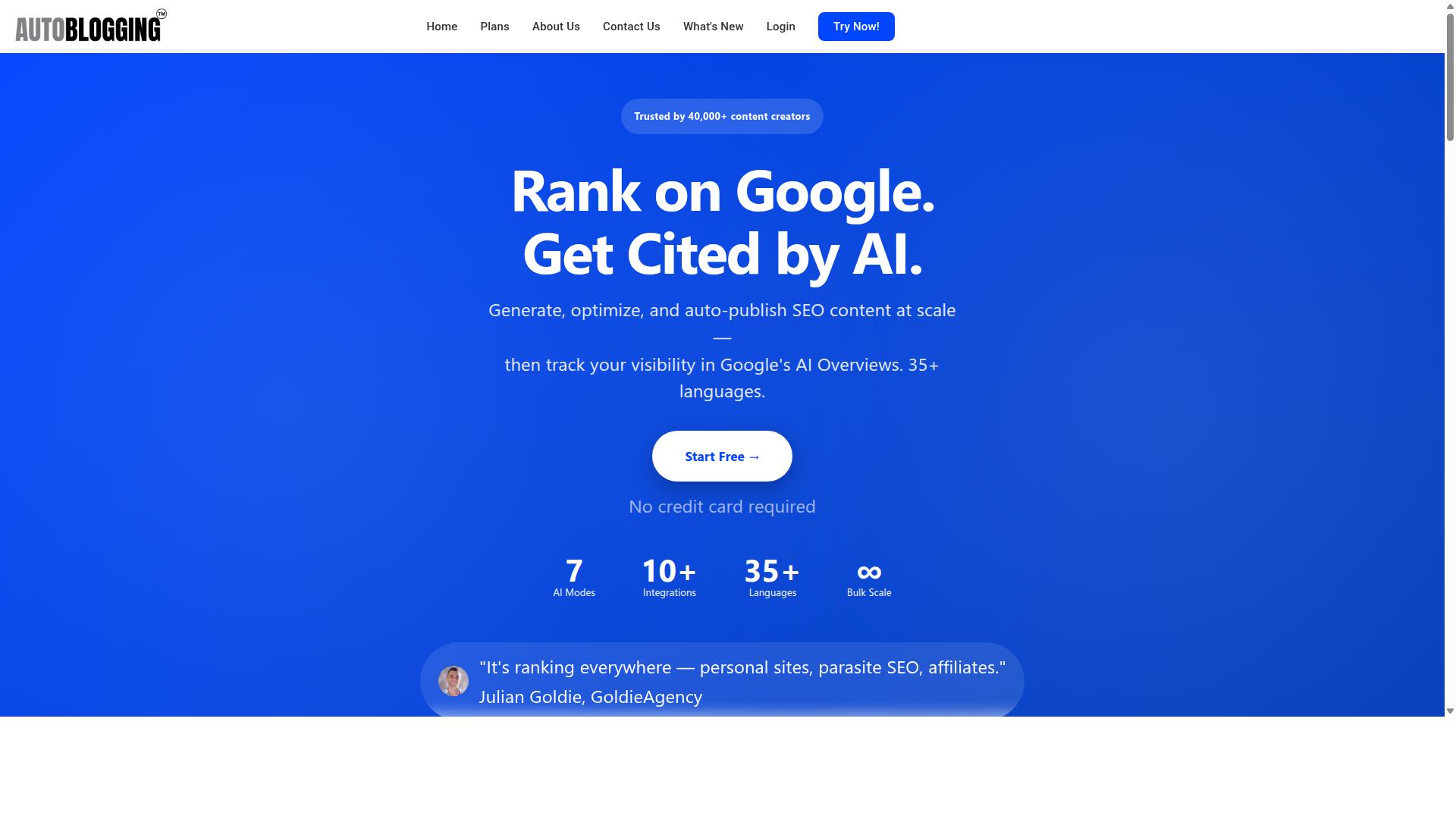
Autoblogging.ai is a SaaS platform that uses artificial intelligence to generate and optimize blog content, positioning itself within the broader trend of automated content creation tools. It is a product of Digimetriq.com, built with a clear mission: help bloggers, website owners and agencies save time and improve their online presence through cutting-edge technology.
At its core, the platform performs two connected jobs. First, it produces article drafts using AI. Second, it shapes that content for search engines so it has a fair shot at ranking. Generation and optimization happen in one workflow, rather than across two or three disconnected tools.
This places Autoblogging.ai inside the wider shift toward automated content generation. Where traditional publishing required a writer, an editor, and an SEO specialist, AI platforms compress much of that pipeline into software. The result is faster output and lower overhead for the people running the sites.
The technology behind this category relies on natural language processing and large language models. These systems learn patterns from vast amounts of text, which lets them produce readable prose on a given topic. Optimization layers then apply on-page and semantic signals that search engines tend to reward.
Autoblogging.ai also states a broader philosophy. It aims to cut down content costs and give the power to human counterparts in standard operating procedures with the first draft. That framing matters: the tool is positioned as a way to remove the blank-page problem and the repetitive early work, not to replace the judgment a site owner brings to strategy and editing.
In the AI content optimization landscape, tools in this class sit between pure writing assistants and dedicated SEO analysis platforms. Autoblogging.ai occupies that middle ground, handling both the drafting and the search-facing refinement that follows.
Who It Serves: Bloggers, Agencies, and SEO Professionals
Autoblogging.ai targets a specific set of users: bloggers who need consistent content, SEO professionals focused on ranking, and agencies managing multiple client sites. The brand lists its audience as bloggers, website owners, SEO professionals, marketing agencies, content creators, and affiliate marketers.
Each group uses the platform for a slightly different reason. The common thread is volume. Producing enough content to stay visible is expensive and slow when every article starts from scratch.
- Bloggers get a way to publish on a steady schedule without writing every post personally, which matters for personal sites and portfolio sites that need regular updates.
- SEO professionals can scale content production across many target keywords instead of rationing output by available writing hours.
- Marketing agencies can serve more clients without proportionally growing their writing team, since draft production is handled before human review.
- Affiliate marketers can build out affiliate sites and support parasite SEO placements where volume and speed often decide who ranks first.
The supported use cases reflect that range: personal sites, parasite SEO, affiliate sites, client websites, portfolio sites, and local sites. A local business site and a large affiliate operation have very different content needs, but both depend on consistent publishing to hold search visibility.
For agencies in particular, the economics are straightforward. Client work is billed per project or retainer, so the cost of producing each draft directly affects margin. Reducing the time spent on first drafts frees capacity for strategy, link building, and the editorial polish that clients actually notice.
For individual bloggers and affiliate marketers, the benefit is simpler: more content published per week without hiring. That output compounds over time as a site's library grows and covers more of the topics its audience searches for.
Digimetriq, the company behind the platform, frames the goal around saving time and improving online presence. The stated approach is to cut content costs and support human workflows with the first draft, with a longer-term aim of handling more of that work outright. For the users above, that translates into a practical trade: less time drafting, more time on the decisions that shape whether a site succeeds.
How Much Does Autoblogging.ai Cost? Pricing Plans Explained
Autoblogging.ai offers a tiered pricing structure with monthly and annual options, ranging from a $19 Starter plan to a $999 Enterprise plan. That range covers casual bloggers testing automated content generation for the first time, all the way up to large operations producing thousands of articles per month.
The pricing model rests on two simple ideas. First, you can pay monthly or annually, with annual billing costing less per month. Second, every plan is built around credits, which correspond to article generation capacity.
In other words, a credit is the unit that measures how much content you can produce. The more credits a plan includes, the more articles you can generate within a billing cycle. This makes it easy to match a subscription plan to your actual output needs instead of guessing.
New accounts also receive 10 free credits per month with no credit card required, so you can try the platform before committing to a paid tier. If you need more capacity than your plan allows, additional credits are available for purchase.
Payment is straightforward: Visa, MasterCard, American Express, and PayPal are accepted, with bank transfers available for annual enterprise plans through Stripe. You can cancel anytime. The sections below break down the monthly tiers, then explain how annual billing and credit rollover change the math.
Monthly Plans: From Starter at $19 to Enterprise at $999
The monthly plans start at $19 for 40 credits and scale up to $999 for 5,000 credits, with six tiers in between. Each tier is designed for a different type of user, so the right choice depends on how much content you publish.
| Plan | Monthly Price | Credits | Best For |
|---|---|---|---|
| Starter | $19 | 40 | Hobbyists and first-time users |
| Regular | $49 | 120 | Small blogs |
| Standard | $99 | 300 | Growing sites |
| Gold | $179 | 600 | Agencies |
| Premium | $249 | 1,000 | High-volume users |
| Enterprise | $999 | 5,000 | Large-scale operations |
A credit typically represents one article generation, though the exact consumption can depend on the mode you choose. That means the credit count on each tier gives you a rough ceiling on how many pieces of content you can produce per month.
For a hobbyist, 40 credits on the Starter plan is plenty to keep a personal blog active without overspending. Small blogs on the Regular plan get more breathing room, while growing sites on Standard can publish consistently.
Agencies managing multiple client sites often gravitate to Gold, and high-volume users on Premium get 1,000 credits for larger content pipelines. Enterprise, at 5,000 credits, suits large-scale operations that treat automated content generation as a core part of their workflow.
Annual Plans and Credit Rollover: Where the Real Savings Are
Annual billing typically offers a discount over monthly rates, and unused credits roll over to the next month, providing flexibility and cost savings. Both features work together to lower your effective cost per article.
When you pay yearly, the monthly equivalent drops noticeably. For example, the Starter plan falls from $19 per month to $12 per month when billed annually at $148 per year. The Regular plan drops from $49 to $32 per month at $382 per year.
The same pattern holds across the higher tiers:
- Standard: $64 per month, billed yearly at $772
- Gold: $116 per month, billed yearly at $1,396
- Premium: $162 per month, billed yearly at $1,942
- Enterprise: $649 per month, billed yearly at $7,792
Credit rollover matters just as much. If you are on the $49 Regular plan and do not use all 120 credits in a given month, the leftovers carry over instead of expiring. Over time, that lets you accumulate a reserve for a bulk project, such as a seasonal content push or a full site refresh.
For anyone comparing subscription plans, this combination is a key differentiator. You get a lower monthly fee through annual billing and you avoid wasting credits during slower months. Together, they make the effective cost of automated content generation easier to justify, whether you are running a single blog or managing content at scale.
What You Get for the Price: Content Optimization Features
The value of Autoblogging.ai lies in its features, which include advanced AI modes, bulk generation, and seamless WordPress integration. Each capability targets a different part of the content workflow, from research to publishing.
Understanding what sits behind the subscription matters when comparing AI autoblogging tools on price alone. A lower monthly fee means little if the platform cannot produce content that ranks or scale output across a site.
Autoblogging.ai bundles several distinct tools under one roof:
- Godlike Mode for SERP competitor analysis and semantic optimization
- Bulk Generation for producing articles at scale from a CSV file
- Site Optimizer for auditing and improving existing content
- WordPress integration for one-click publishing to unlimited sites
- Additional modes including Quick Mode, News Mode, and Amazon Reviews Mode
Together, these features shape how the platform's pricing tiers translate into practical output. The sections below break down what each one does and why it factors into the overall cost picture.
Godlike Mode, SERP Competitor Analysis, and Semantic SEO
Godlike Mode is Autoblogging.ai's premium feature that analyzes top-ranking competitors to generate semantically optimized content. It examines what already ranks on a given query, then uses that data to shape the article it produces.
The process relies on three connected steps. First, SERP competitor analysis reviews the pages currently occupying top positions. Second, the tool extracts LSI keywords, the related terms and phrases that signal topical depth to search engines. Third, knowledge graph extraction identifies entities and their relationships, giving the generated content a stronger semantic foundation.
This matters because modern search evaluation goes beyond exact keyword matches. Tools built on large language models and natural language processing can weave related concepts into a draft instead of repeating a single phrase. That is the core of semantic SEO: covering a topic the way an informed writer would.
A concrete example makes this clearer. If you generate an article on "AI content optimization," a semantically aware draft may naturally reference entities such as natural language processing and GPT-4. Those additions help the piece compete for related queries, not just the primary term.
For buyers weighing subscription costs, this is the feature tier that separates a basic generator from a research-backed writing tool. It is the main reason Godlike Mode sits at the premium end of the platform's tiered pricing.
Bulk Generation, Site Optimizer, and One-Click WordPress Publishing
For scaling content, Autoblogging.ai offers bulk generation, a site optimizer, and one-click publishing to WordPress. These three features address volume, refinement, and delivery, the stages where manual workflows tend to slow down.
Bulk Generation produces up to 500 articles from a single CSV upload. Instead of prompting the tool one article at a time, you supply a list of topics or keywords and let the platform work through them. For agencies and site owners managing multiple properties, this is the feature that turns a monthly fee into measurable output.
The Site Optimizer works in the opposite direction. It analyzes content already published on your site and identifies SEO improvements, helping you refresh older pages rather than only adding new ones. That makes it useful for sites with an existing archive that has lost rankings or never gained them.
Publishing is handled through WordPress integration, which supports unlimited sites, one-click posting, a plugin, and scheduled auto-posting. Beyond WordPress, Autoblogging.ai connects to Web 2.0 platforms including Medium, Dev.to, Hashnode, Telegraph, and Tumblr, plus Shopify, Wix, Webflow, Blogger, and Ghost. API access, Zapier, and n8n round out the automation options.
Read together, these features cut the manual steps between idea and live post, which is often the hidden cost in any automated content generation setup.
Is Autoblogging.ai Worth the Cost? Value Compared to Manual Content Production
To determine if Autoblogging.ai is worth the cost, compare its pricing to the expense of hiring human writers or using other AI tools. The math usually favors automation once you look beyond the sticker price of a single article.
A freelance writer typically charges $50 to $200 for one 1,000-word article, depending on niche and experience. Multiply that across a content calendar of even a few posts per week, and the monthly bill climbs quickly. An entry-level subscription to an AI autoblogging tool, by contrast, often sits well below the cost of a single freelance piece.
The comparison gets sharper when you account for volume. A low-cost plan can support many articles per month rather than one. That shifts content production from a per-piece expense into a predictable subscription line item.
Time Savings: Hours Versus Minutes
Manual writing is slow. Research, outlining, drafting, editing, and formatting can consume several hours for a single polished post. Automated content generation compresses that timeline dramatically, producing a draft in minutes rather than hours.
That speed matters most for teams that need consistent output. When drafting is fast, editors can spend their time refining and optimizing instead of starting from a blank page. Time reclaimed is a real cost saving, even if it never appears on an invoice.
ROI: When a Ranking Article Pays for Itself
Return on investment depends on whether content earns traffic. If an article ranks and attracts visitors, the value can far exceed the cost of producing it. A single well-performing post may justify an entire month of subscription fees.
Consider a simple scenario. One article that brings steady organic traffic and converts even a handful of readers can cover the cost of many low-tier plans. Scale that across a library of posts, and the cumulative return grows over time.
Not every article will rank, and results vary by niche and competition. Still, the downside is limited: a modest monthly fee versus the fixed cost of hiring writers for every piece.
How Competitor Pricing Compares
Pricing across AI writing tools varies widely. Platforms such as Jasper AI, Copy.ai, Writesonic, Article Forge, and Rytr each structure their plans differently, with some charging by seat and others by word or credit.
Many general-purpose tools bundle features that go beyond autoblogging, which can push their monthly fees higher. Specialized autoblogging tools tend to keep pricing focused on publishing workflows. That focus often translates into a lower entry cost for the same core task.
Buyers should weigh what they actually need. A tool priced for broad marketing teams may be overkill for someone who simply wants consistent blog output. Matching the plan to the job keeps costs in check.
The Verdict on Value
For most content operations, the cost comparison comes down to scale and consistency. Manual production offers control and a human voice, but at a premium per article. Automated generation trades some polish for speed and volume.
The strongest approach often blends both. Use automation for drafting and volume, then apply editing and optimization to protect quality. This keeps cost per published article low while maintaining standards.
Judged on price alone, an affordable autoblogging subscription competes well against freelance rates and many general AI platforms. The real question is whether the output supports your goals. When it does, the value is clear.
Trust Signals: 40,000+ Users, 1M+ Articles, and a 4.9 Rating
Autoblogging.ai has generated over 1 million articles for more than 40,000 users and holds a 4.9 average rating, indicating strong market trust. Those numbers matter in a category where many tools appear, promise a lot, and quietly disappear within a year.
A user base of 40,000+ content creators is not a vanity figure. It reflects bloggers, affiliate marketers, agencies, and small business owners who keep coming back because the output meets a standard they can publish under their own name.
The 1M+ articles generated milestone says something similar. Volume at that scale only happens when people finish their first batch and decide to run a second, then a third. Retention is the real signal behind the count.
A 4.9 average rating rounds out the picture. Ratings are easy to game in the short term and hard to sustain over time, especially once a tool has tens of thousands of users leaving feedback.
Trust in this space is not built on marketing copy. It is built on whether the tool delivers articles that rank, read naturally, and do not require hours of cleanup before publishing.
Autoblogging.ai supports this with a human proofreader included in all plans, one-click WordPress publish, and a 21-point SEO audit. These are the kinds of safeguards that turn a first-time trial into a long-term subscription.
Beyond the raw metrics, credibility often comes down to who is willing to put their name behind a product. Autoblogging.ai counts notable figures in the SEO and content marketing space among its users, including Julian Goldie of GoldieAgency and James Dooley of FatRank.
Both operate in highly competitive niches where content quality directly affects rankings and revenue. Their association suggests the platform meets a professional bar, not just a beginner-friendly one.
For readers weighing whether Autoblogging.ai is a legitimate option, these signals answer the question directly. A large active user base, a high sustained rating, and endorsements from recognized practitioners point to a tool that has earned its place.
Ongoing development reinforces that trust. New features are shipped weekly, which means the platform is not coasting on past success. Tools that stop evolving tend to fall behind as search algorithms and content standards shift.
24/7 support is also available, so users are not left waiting days for answers when something needs attention. For anyone running content operations at scale, reliable support is not a nice-to-have, it is part of the cost of doing business.
Together, these trust signals form a coherent story: a platform used by tens of thousands, rated highly by those users, endorsed by respected names, and actively maintained. That combination is what separates a durable tool from a passing trend in the AI autoblogging market.
Who Should Use Autoblogging.ai - and Which Plan Fits
Choosing the right plan depends on your content volume and budget; here's a breakdown by user type. Autoblogging.ai uses a credit-based system where each credit corresponds to generated content, so matching your plan to your actual output is the fastest way to control costs.
Before picking a tier, answer three practical questions. How many sites will you publish to? How many articles do you need each month? And do you need bulk generation for multiple projects at once? Your answers will point you toward the right subscription level far more reliably than picking the cheapest or most popular option.
Bloggers just starting out should look at the Starter plan at $19 per month, which includes 40 credits. If you publish a handful of posts monthly and are still testing your niche, this keeps your monthly fees low while you learn what works. The Regular plan at $49 per month with 120 credits suits beginners who have found traction and want a steadier publishing rhythm.
Growing blogs and small agencies typically need more headroom. The Standard plan at $99 per month provides 300 credits, while Gold at $179 per month offers 600 credits. These tiers fit teams managing several client sites or a blog scaling toward daily publishing. At this stage, the cost per article drops meaningfully compared with entry tiers, which matters when content is a core business expense.
Large agencies and high-volume users should consider Premium at $249 per month with 1,000 credits, or Enterprise at $999 per month with 5,000 credits. These plans suit operations running automated content generation across many domains, where predictable capacity and tiered pricing keep budgeting simple.
Annual billing changes the math considerably. Paying yearly lowers the effective rate on every tier: Starter $12/mo ($148/year), Regular $32/mo ($382/year), Standard $64/mo ($772/year), Gold $116/mo ($1,396/year), Premium $162/mo ($1,942/year), and Enterprise $649/mo ($7,792/year). If you are confident in your publishing schedule, annual plans cut costs substantially.
Two features ease the decision. All plans include credits rollover, so unused capacity is not wasted in a slow month. New accounts also receive 10 free credits per month with no credit card required, which lets you evaluate output quality before committing. Additional credits can be purchased whenever you need a short-term boost.
- Starter ($19/mo): new bloggers testing a niche with light publishing needs
- Regular ($49/mo): beginners with early traction who publish consistently
- Standard ($99/mo): growing blogs and small agencies managing a few sites
- Gold ($179/mo): teams scaling toward daily output across client projects
- Premium ($249/mo): high-volume publishers and larger agencies
- Enterprise ($999/mo): operations needing maximum monthly capacity
For organizations that prefer not to manage generation themselves, Done For You packages are available: Starter at $1,200, Pro at $1,600, Corp at $4,000, and Senpai at $10,000, each covering 1,000 articles. These suit businesses that want finished content delivered rather than credits to spend.
Payment is flexible, with Visa, MasterCard, American Express, and PayPal accepted, plus bank transfers for annual enterprise plans. You can cancel anytime, which lowers the risk of starting small and upgrading as your needs grow. Match your plan to your real monthly output, lean on rollover and the free credits to test, and the right tier becomes clear.
Final Verdict: Is Autoblogging.ai the Right Content Optimization Investment?
Autoblogging.ai offers a compelling mix of features, pricing, and trust signals that make it a strong candidate for anyone serious about content optimization. The platform pairs Godlike Mode and bulk generation with subscription plans that include rollover, so unused capacity does not simply vanish at the end of a billing cycle. For buyers comparing monthly fees across AI autoblogging tools, that combination of capability and flexibility is worth weighing carefully.
Cost is only one side of the equation. A tool can look cheap on paper yet cost far more in wasted hours if the output needs heavy rewriting. Autoblogging.ai targets that problem directly through automated content generation designed for scale, which matters to anyone publishing frequently or managing multiple sites.
Trust signals also carry weight in this category. The company publishes verifiable contact channels and physical addresses rather than hiding behind a web form, which is a meaningful signal for a SaaS purchase. Buyers evaluating tiered pricing or enterprise licensing can reach a real team before committing budget.
- Godlike Mode for users who want maximum output quality from the platform
- Bulk generation for producing content across many topics or sites at once
- Rollover on subscription plans, so unused allowance carries forward
- Published contact details and office locations in India and the United Kingdom
Who benefits most? Bloggers scaling a single site, agencies juggling client accounts, and SEO professionals who need volume without losing control of quality. Each of those groups tends to feel the same pain: content demand grows faster than the budget or the team. A tool built around bulk generation addresses that gap more directly than a general-purpose writing assistant.
It is worth being clear about what a verdict like this can and cannot promise. No pricing page or feature list guarantees rankings, traffic, or revenue. What Autoblogging.ai offers is a defined set of capabilities, a transparent cost structure, and reachable support. Whether that translates into return depends on your niche, your editorial standards, and how consistently you publish.
For readers still deciding, the practical path is straightforward. Start with the free plan, test output against your own quality bar, then compare the paid tiers against the monthly fees you would otherwise spend on freelance writing or separate tools. If the numbers work, the rollover structure means you are not paying for capacity you failed to use.
For questions before or after signing up, the team can be reached directly:
- Email: [email protected]
- Phone/WhatsApp: +91 84605-06553
- Availability: 7:00-19:00 IST
If you are weighing AI autoblogging tools for content optimization, the sensible next step is to try the free plan and see how the output fits your workflow. From there, the website lays out the full range of subscription options so you can match a plan to your actual publishing volume.
Frequently Asked Questions
How much does Autoblogging.ai cost, and which plan is right for me?
Autoblogging.ai offers monthly plans starting at $19 for 40 credits (Starter), then $49 for 120 credits (Regular), $99 for 300 credits (Standard), $179 for 600 credits (Gold), $249 for 1,000 credits (Premium), and $999 for 5,000 credits (Enterprise). Annual plans are also available and billed yearly, which typically suits bloggers and agencies who publish consistently. If you're just testing the waters, start small; if you're running client sites or affiliate portfolios at scale, a higher-credit plan gives you more room to generate without interruptions.
What exactly is a "credit," and do unused credits expire?
Credits are what you spend to generate articles and use the platform's AI modes, and each plan includes a set number per month. The good news is that credits roll over, so you don't lose what you haven't used in a given month. That makes it easier to stockpile credits during quieter periods and spend them when you're publishing heavily.
Can I try Autoblogging.ai before paying?
Yes - Quick Mode is free and available in both single and wizard formats, so you can generate content and get a feel for the platform before committing to a paid plan. Once you see how the output fits your workflow, you can upgrade to a plan that matches your volume. This is a low-risk way to evaluate whether the tool suits your blog or client projects.
What's the difference between Quick Mode and Godlike Mode?
Quick Mode is the free, straightforward option for fast single or wizard-based generation. Godlike Mode goes deeper: it analyzes SERP competitors, pulls in LSI keywords, and extracts knowledge graphs to produce more thoroughly optimized content. If SEO performance matters for a given article, Godlike Mode is the better choice; for quick drafts or testing, Quick Mode does the job.
Can I generate articles in bulk or in languages other than English?
Yes. Bulk Generation lets you create up to 500 articles at once via CSV, which is ideal for agencies and affiliate marketers managing multiple sites. Autoblogging.ai also supports 35+ languages, so you can produce content for global audiences rather than being limited to English.
Does Autoblogging.ai connect with the tools I already use?
Autoblogging.ai offers 35+ integrations, so it can fit into most existing content workflows rather than forcing you to change everything. It's also built with bloggers, SEO professionals, agencies, and affiliate marketers in mind, serving personal sites, client websites, and portfolio sites alike. If you rely on a specific tool, it's worth checking the integrations list before you commit to a plan.
Recommended Resources: